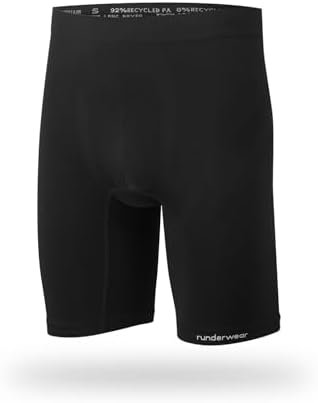
Mile 14 is when you notice it. A slow burn on the inner thigh that becomes a friction point you can’t un-feel for the rest of the run. You adjust your stride. You shorten your step. By mile 18, your race strategy has become about damage control.
Chafing ends good training days. And most runners are solving it with the wrong tool — anti-chafe balm instead of fabric that doesn’t cause the problem in the first place.
What Most Anti-Chafe Underwear Gets Wrong
The running gear industry has turned moisture-wicking into a first principle. If a fabric wicks sweat, the logic goes, it keeps you dry, and dry skin doesn’t chafe. Both halves of that equation are wrong.
Synthetic fabrics — polyester, nylon, spandex blends — do move moisture. But they do it by creating a low-friction film on the fabric surface. At mile 6 that feels dry. At mile 14, when the fabric is repeatedly sliding against the same skin under load, the synthetic surface creates consistent mechanical abrasion that accumulates. Seams in synthetic fabric harden when wet. Waistbands stiffen. The same properties that make synthetics feel slick at first make them abrasive over distance.
Natural fibers respond to moisture differently. Cotton softens when wet. A damp natural fiber fabric becomes more pliable against skin, not less. The friction profile changes in your favor rather than against you.
Choosing anti-chafe underwear is fundamentally a friction management problem. Fabric that changes character for the worse when wet is not your ally over long distances.
What to Look For in Anti-Chafe Underwear
Natural Fiber Softness at Distance
The key variable isn’t how a fabric feels at the start — it’s how it behaves at hour two. Natural fiber underwear maintains or improves its surface feel as it absorbs moisture. Look for high-cotton-content options with a small elastane component for stretch. Pure cotton without elastane can bunch; the blend matters.
Flat or Welded Seam Construction
Seams are the second major chafe source after fabric choice. Look for flatlock seams that lie parallel to skin rather than raised seams that create a ridge. Some premium options use bonded seams with no thread at all. This matters more in the inner thigh area than anywhere else.
Waistband Construction Without Chemical Stiffeners
A waistband that stays soft after sweat exposure won’t saw at your hip flexor area during long efforts. Chemical stiffeners applied to synthetic elastic waistbands harden with heat and moisture. Natural cotton inlay under the waistband maintains softness regardless of sweat volume. Organic cotton boxers with cotton-lined waistbands solve this specific problem.
Moisture Handling Appropriate to the Duration
Short runs favor highly hydrophobic synthetics. Long runs favor fabrics that manage accumulated moisture — which cotton does through absorption and gradual release. If your runs regularly exceed 90 minutes, the moisture profile at sustained effort is more relevant than the peak-dryness profile at 20 minutes.
Durability Over a Training Block
Chafing issues often emerge not from new underwear but from underwear that’s degraded over a season. Synthetic fabrics pill and develop micro-tears at friction points. High-quality organic cotton maintains surface integrity longer, keeping the friction profile consistent across a 16-week training block.
Practical Anti-Chafe Habits for Long-Distance Runners
Address the highest-friction zone first. Inner thigh and waistband account for over 90% of running-related chafe. A great fabric choice at those two points outperforms anti-chafe cream over the full race distance.
Test your race-day gear on your longest training run. Nothing should be worn for the first time on race day. That includes underwear. Your longest long run is the test environment that most closely predicts race conditions.
Carry the right backup. For ultras and multi-hour events, a small amount of natural balm as a top-up is reasonable. But think of it as insurance, not your primary strategy. If you’re applying balm every 5 miles, you have a fabric problem.
Wash and inspect after every long run. Fabric failures are visible before they cause injury. Inspect seams, waistbands, and friction zones for pilling or wear. Replace before the garment fails during training.
For runners targeting distances where chafing has ended previous attempts, pairing organic cotton boxers with flatlock seam construction is the most direct fabric-level intervention available.
Why Fabric Choice Is a Training Continuity Issue
Chafing isn’t just uncomfortable. It’s a training disruption. A bad chafe incident on a Saturday long run can keep you off the road for two to four days while skin heals. Over a 20-week marathon build, losing three or four training days to recurring chafing is the difference between arriving at the start line prepared and arriving undertrained.
Runners who solve chafing with better fabric run more miles. That’s the entire argument. Anti-chafe cream dependency works until it doesn’t. Fabric that doesn’t cause the problem works every time.
The cost of a quality pair of natural-fiber underwear is measured in dollars. The cost of a training week lost to a chafing injury is measured in fitness and race-day readiness. The math is straightforward.