Introduction
Modern engineering projects are becoming increasingly complex. Engineers working in aerospace, automotive, energy, manufacturing, electronics, and other industries often need to understand how fluids, gases, heat, and other physical forces behave under demanding conditions. Computational Fluid Dynamics (CFD) has become an essential technology for studying these behaviors without relying entirely on expensive physical prototypes. However, advanced CFD models can require enormous amounts of computational power.
This is where CFD simulation high performance computing becomes especially valuable. By combining CFD software with High Performance Computing (HPC) resources, engineering teams can solve larger and more detailed simulations in significantly less time. This approach supports faster development, better engineering decisions, and more efficient product optimization.
Understanding CFD and High Performance Computing
Computational Fluid Dynamics uses numerical methods to analyze fluid flow and related physical phenomena. Instead of testing every design through physical experiments, engineers can create a digital representation of a system and simulate conditions such as airflow, pressure, turbulence, temperature, and heat transfer.
HPC takes this capability further by providing powerful computing resources capable of processing large workloads in parallel. Traditional computers may struggle with highly detailed CFD models because these simulations can contain millions or even billions of computational elements. HPC systems divide complex workloads across multiple processors, allowing calculations to be completed more efficiently.
The combination creates a powerful engineering environment in which sophisticated simulations can be performed within practical project timelines.
Faster Simulation and Reduced Engineering Time
One of the most important advantages of CFD simulation high performance computing is improved simulation speed. Complex CFD models may take many hours or even days to solve on conventional workstations. HPC environments can distribute computational tasks across multiple CPU cores or other computing resources.
Faster simulations allow engineers to evaluate more design variations during the same development period. Instead of waiting several days to analyze one configuration, a team may be able to investigate multiple alternatives much more quickly.
This shorter simulation cycle can accelerate product development and help organizations respond faster to changing engineering requirements.
Handling More Complex CFD Models
Modern engineering applications frequently demand highly detailed simulations. Engineers may need to model complicated geometries, transient flow behavior, turbulence, multiphase systems, combustion, thermal interactions, or fluid-structure interactions.
These applications can require substantial memory and processing capacity. HPC infrastructure makes it practical to work with larger computational meshes and more sophisticated physical models.
For example, an aerospace engineer studying airflow around an aircraft component may need a highly refined mesh around specific surfaces while maintaining a large overall simulation domain. HPC resources can provide the computational capacity needed to process such demanding models.
Supporting Design Optimization
Engineering design rarely involves evaluating only one configuration. Engineers typically need to compare different geometries, materials, operating conditions, and performance targets.
With CFD simulation high performance computing, design teams can run more simulations within a limited timeframe. This supports optimization processes in which multiple design variables are tested systematically.
Engineers can investigate questions such as:
- Which geometry produces lower aerodynamic drag?
- How can cooling performance be improved?
- What design provides more efficient airflow?
- How can pressure losses be minimized?
- Which operating condition produces the best overall performance?
The ability to perform more simulations creates a stronger foundation for data-driven engineering decisions.
Reducing the Need for Physical Prototypes
Physical prototypes remain important in engineering, but developing and testing them can be expensive and time-consuming. CFD simulations can help engineers identify promising designs before manufacturing physical prototypes.
HPC makes this virtual testing approach more powerful by enabling detailed simulations within shorter development cycles. Engineers can eliminate unsuitable concepts digitally and focus physical testing on the most promising options.
This can reduce material costs, laboratory requirements, and prototype iterations. Although CFD does not completely replace experimental validation, it can significantly reduce the number of physical tests required during early-stage development.
Improving Engineering Accuracy and Insight
A major benefit of advanced CFD is the amount of information it can provide about a system. Physical testing may offer measurements at selected locations, while CFD can provide detailed information across the computational domain.
Engineers can examine velocity fields, pressure distributions, temperature variations, turbulence characteristics, and other important variables. HPC allows these simulations to use finer computational resolutions when additional detail is necessary.
Higher-resolution models can provide deeper insight into complex flow behavior. However, engineers must still select appropriate physical models, boundary conditions, mesh strategies, and numerical settings. More computing power does not automatically guarantee accurate results.
Applications Across Modern Industries
The use of CFD simulation high performance computing extends across many engineering sectors.
In aerospace, engineers use CFD to study aerodynamic performance, thermal management, propulsion systems, and airflow around aircraft components.
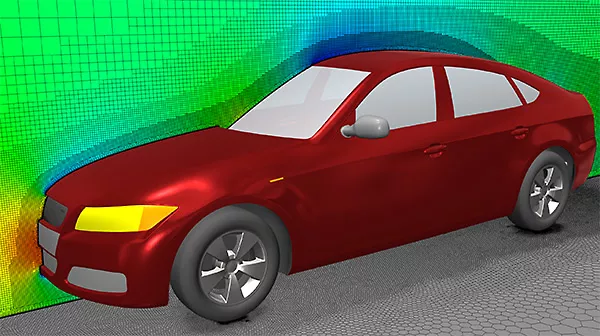
In automotive engineering, CFD supports aerodynamic optimization, engine cooling, cabin ventilation, thermal management, and vehicle performance studies.
Energy companies can use CFD to investigate turbines, heat exchangers, combustion systems, cooling technologies, and renewable-energy equipment.
In electronics and data-center applications, CFD can help analyze airflow and thermal conditions around high-performance equipment.
Manufacturing industries can also use CFD for processes involving fluid flow, heat transfer, mixing, cooling, and other physical phenomena.
Enabling Parallel Engineering Workflows
HPC does more than simply make one simulation faster. It can support broader engineering workflows involving numerous simulations.
For example, automated design studies can generate multiple geometry variations and evaluate them using predefined CFD parameters. HPC resources can process these cases efficiently, allowing engineering teams to explore a much larger design space.
This is particularly useful when CFD is combined with optimization algorithms, surrogate models, artificial intelligence, or machine learning. Large collections of simulation results can provide valuable datasets for identifying performance trends and improving future designs.
Better Cost and Resource Management
Although implementing HPC infrastructure requires investment, the long-term benefits can be substantial for organizations that perform frequent computational simulations.
Faster simulation turnaround can improve engineering productivity. Teams can complete more analysis without proportionally increasing personnel or project duration. Reduced dependence on repeated physical prototypes can also contribute to cost savings.
Cloud-based HPC environments provide another option for organizations that do not want to maintain extensive on-premises computing infrastructure. Companies can access additional computational resources when workloads increase and scale them according to project requirements.
Making CFD More Accessible to Engineering Teams
As engineering software and computing platforms continue to evolve, CFD is becoming increasingly integrated into digital engineering workflows. Training engineers to use CFD effectively alongside HPC can help organizations take greater advantage of simulation technology.
Successful implementation requires more than access to powerful hardware. Engineers need knowledge of fluid dynamics, numerical methods, meshing, solver settings, post-processing, and validation. Understanding how to configure simulations efficiently is essential for obtaining reliable results while controlling computational costs.
Conclusion
CFD simulation high performance computing provides modern engineering teams with the computational capability needed to analyze increasingly complex problems. Faster simulation times, larger computational models, improved design optimization, reduced prototype requirements, and deeper engineering insight are among its most significant advantages.
As products and systems become more sophisticated, simulation will continue to play an important role in engineering development. By combining advanced CFD methodologies with HPC resources, organizations can explore more design possibilities, make informed decisions, and shorten development cycles. The result is a more efficient and data-driven approach to solving the engineering challenges of today and tomorrow.