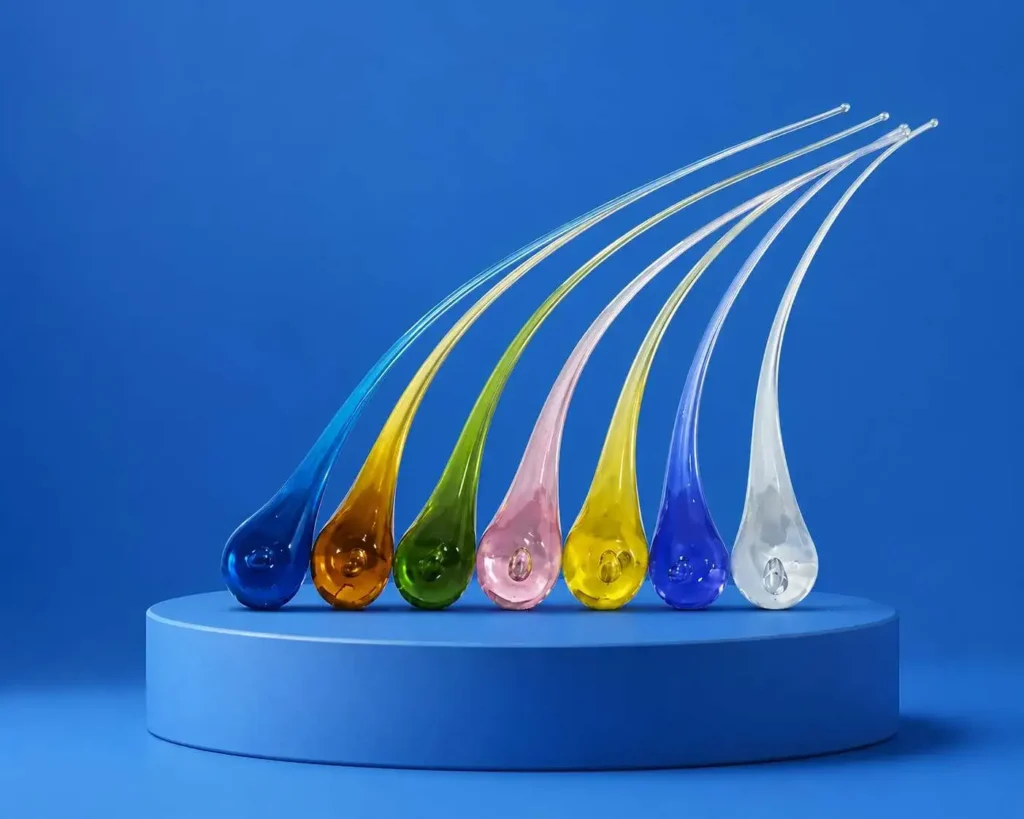
A prince rupert’s drop is one of the most fascinating demonstrations of how glass can behave in seemingly contradictory ways. It looks like an ordinary teardrop-shaped piece of glass, yet the thick rounded head can withstand surprisingly strong impacts. At the same time, its thin tail is extremely fragile, and a small amount of damage to that tail can cause the entire drop to shatter explosively into tiny fragments.
This unusual combination of strength and fragility has made the prince rupert’s drop an important example in discussions about glass, stress, fracture mechanics, and materials science. Understanding how it works provides an excellent look at how internal stresses can dramatically change the behavior of a material.
What Is a Prince Rupert’s Drop?
A prince rupert’s drop is a small glass object created by allowing molten glass to fall into cold water. As the hot glass enters the water, its outer surface cools and solidifies very quickly. The inside of the drop remains hot for longer, allowing the material to contract as it eventually cools.
This uneven cooling process creates powerful internal stresses throughout the glass. The result is a distinctive shape consisting of a large, rounded head connected to a long, thin tail.
The drop is named after Prince Rupert of the Rhine, a 17th-century European prince associated with an early scientific interest in the phenomenon. The remarkable properties of these glass drops have fascinated scientists and observers for centuries.
Although glass is commonly thought of as brittle, a prince rupert’s drop demonstrates that its strength can depend greatly on how stresses are distributed inside the material.
How Is a Prince Rupert’s Drop Made?
Creating a prince rupert’s drop requires molten glass and water. A small amount of molten glass is allowed to fall directly into a container of cold water.
The sudden temperature difference is crucial. The outer surface of the molten glass cools rapidly and becomes solid while the interior remains relatively hot. As the interior gradually cools, it attempts to contract. However, the already-solid outer layer restricts this movement.
This creates a complicated stress pattern within the glass.
The exterior of the rounded head ends up under strong compressive stress, while the interior experiences tensile stress. Compression essentially squeezes the surface together, making it difficult for cracks to open and spread.
The thin tail, however, contains stresses that make it extremely sensitive to damage. If the tail is broken, the stored elastic energy can be released almost instantaneously, causing the entire drop to disintegrate.
The Secret Behind Its Incredible Strength
The most important feature of a prince rupert’s drop is compressive stress at its surface.
Glass is very strong when it is compressed but much weaker when it is subjected to tension. A crack in glass normally grows when forces pull the crack surfaces apart. If the surface is under compression, however, those forces work against crack growth.
The rapid cooling process effectively places the outer layer of the drop into compression. This protective layer can prevent small surface cracks from developing into larger fractures.
This principle is also used intentionally in manufactured glass. Tempered glass, for example, is treated so that its outer surfaces are placed under compression. This makes it considerably more resistant to impact than ordinary untreated glass.
A prince rupert’s drop therefore provides a natural and visually dramatic demonstration of the same basic materials-science principle.
Why Can the Head Survive Strong Impacts?
The rounded head of the drop can withstand surprisingly forceful impacts because its compressed outer surface resists crack formation and propagation.
When an object strikes the head, the force is distributed through the glass. If the impact does not penetrate the compressed surface deeply enough to overcome the internal stress structure, the drop can remain intact.
This does not mean that the glass is indestructible. A sufficiently powerful or appropriately positioned impact can still damage it. The impressive strength comes from the internal stress state rather than from the glass itself being naturally stronger than other types of glass.
The shape also contributes to the drop’s unusual behavior. The rounded head has no sharp corners that would easily concentrate stress, allowing it to tolerate significant impacts.
Why Does the Tail Make the Drop So Fragile?
The thin tail represents the weak point of the prince rupert’s drop.
Unlike the heavily compressed outer region of the head, the tail is particularly vulnerable to cracks. Even a small scratch, cut, or break can initiate a fracture.
Once a crack begins traveling from the tail into the stressed interior, the process can become extremely rapid. The internal tensile stresses provide energy that drives the fracture through the drop.
The result is a spectacular explosion-like breakup. Instead of simply breaking into a few large pieces, the drop can rapidly fragment into numerous tiny pieces.
This behavior illustrates an important principle of fracture mechanics: a material can be extremely resistant to one type of damage while remaining exceptionally vulnerable to another.
Understanding Internal Stress
To appreciate the prince rupert’s drop, it is useful to understand residual stress.
Residual stress is stress that remains inside a material even when no external force is being applied. In the drop, this stress develops because different parts of the glass cool at different rates.
The outer layer freezes first. The inner portion cools later and tries to shrink. Because the outer layer has already become rigid, it restricts the contraction of the interior.
The resulting structure can be thought of as a compressed outer shell surrounding a region under tension.
This balance is invisible to the naked eye. The drop looks like ordinary glass, but its internal mechanical condition is very different.
The Explosive Shattering Effect
The dramatic destruction of a prince rupert’s drop occurs because the material contains stored elastic energy.
When the tail is damaged, a crack can travel rapidly through the stressed glass. As the fracture moves, the internal stress is released.
The crack propagation can happen at extremely high speeds, producing the characteristic explosive disintegration associated with the phenomenon.
The tiny fragments are not created because the glass suddenly becomes chemically unstable. Instead, the mechanical energy stored in the internal stress field is released through rapid fracture.
This makes the drop an excellent demonstration of how stored energy can influence the behavior of solid materials.
What the Drop Teaches Us About Glass
The prince rupert’s drop challenges the simple idea that glass is simply “strong” or “weak.” Its behavior depends on surface condition, internal stresses, geometry, and the location and type of applied force.
A piece of ordinary glass containing a surface crack can fail easily because the crack provides a point where tensile stresses become concentrated. In contrast, a compressed surface can suppress the opening and growth of cracks.
This is why engineered glass products often use controlled cooling or heating processes to create beneficial stress distributions.
Connections to Tempered Glass
Tempered glass is perhaps the most practical example of the same basic concept demonstrated by a prince rupert’s drop.
During tempering, glass is heated and then cooled rapidly under controlled conditions. This produces compressive stress near the surfaces and tensile stress deeper inside.
The result is glass that is more resistant to impacts and thermal stresses than conventional glass.
When tempered glass eventually fails, it can also break into many relatively small pieces rather than forming large, dangerous shards. While the manufacturing process and stress distribution differ from those of a prince rupert’s drop, the underlying idea of using residual stresses to influence fracture behavior is closely related.
Why Scientists Study Prince Rupert’s Drops
Beyond their visual appeal, these glass drops provide a useful model for understanding fracture, residual stress, crack propagation, and material strength.
Researchers can study how cracks move through stressed glass and how changes in the stress field influence fracture behavior. Such knowledge contributes to broader research into stronger and safer materials.
The phenomenon also provides an accessible way to demonstrate concepts that can otherwise be difficult to visualize. Students can learn about compression, tension, thermal contraction, elastic energy, and fracture mechanics through a single unusual glass object.
A Remarkable Example of Materials Science
The prince rupert’s drop is remarkable because it combines apparently opposite properties. Its rounded head can resist substantial impact, while its delicate tail can trigger almost instantaneous destruction.
The explanation lies in its formation. Rapid cooling creates residual stresses that place the outer surface of the glass under compression. That compressed surface helps prevent cracks from opening, giving the head exceptional resistance to impact.
At the same time, energy stored within the stressed structure makes the drop highly unstable when its vulnerable tail is damaged. Once a fracture begins, the stored energy helps drive the crack rapidly through the glass.
Ultimately, the prince rupert’s drop demonstrates one of the most important lessons in materials science: strength is not determined solely by what a material is made of. How that material is shaped, cooled, stressed, and treated can completely transform the way it responds to force.